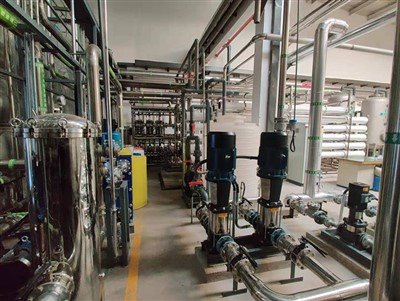
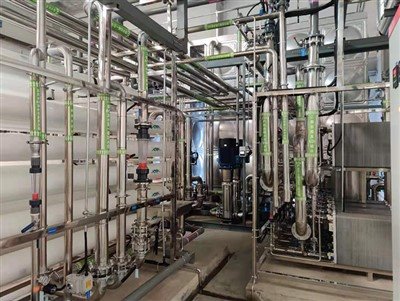
The RO DM Plant System is an advanced water purification solution that combines Reverse Osmosis (RO) and Demineralization (DM) technologies to produce high-purity water with extremely low mineral content. This system is widely used in industries where stable, low-conductivity water is required for manufacturing, boiler feed, electronics production, pharmaceuticals, and chemical processing.
By integrating RO as the primary purification stage and DM ion exchange as the final polishing stage, the system ensures efficient removal of dissolved salts, minerals, silica, and ionic contaminants, delivering reliable high-purity water while reducing operating costs.
System Working Principle
The RO DM plant operates through multiple purification stages to achieve high water purity.
Pretreatment
Pretreatment protects the RO membranes and improves system efficiency.
Typical units include:
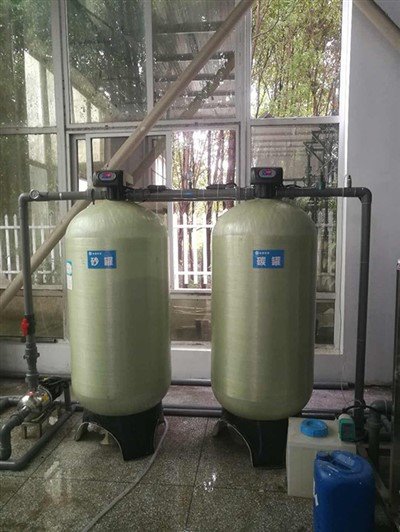
- Multimedia sand filter for suspended solids removal
- Activated carbon filter for chlorine and organic removal
- Water softener (optional) to remove hardness
- Cartridge filter for fine particle filtration
Reverse Osmosis (RO)
The RO system removes 95–99% of dissolved salts, heavy metals, bacteria, and organic contaminants, significantly reducing Total Dissolved Solids (TDS) and preparing the water for the demineralization stage.
Demineralization (DM)
The DM section uses ion exchange resins to remove remaining ionic impurities.
Typical configuration:
- Cation exchange unit – removes positive ions such as calcium, magnesium, and sodium
- Anion exchange unit – removes negative ions such as chloride, sulfate, nitrate, and silica
- Mixed-bed polisher (optional) – provides final high-purity water
Typical Process Flow
Raw Water Tank → Feed Pump → Multimedia Filter → Activated Carbon Filter → Water Softener → Cartridge Filter → RO System → RO Permeate Tank → Cation Exchange → Degasser Tower → Anion Exchange → Mixed Bed Polisher → DM Water Tank → Distribution Pump
Typical Water Quality
|
Parameter |
Typical Value |
|
Conductivity |
≤ 0.2 – 5 µS/cm |
|
Total Dissolved Solids (TDS) |
≤ 1 – 5 ppm |
|
Hardness |
Near zero |
|
Silica |
≤ 0.05 ppm |
|
Chloride |
Ultra-low |
Water quality can be adjusted according to industry requirements.
Key Features
- High-efficiency RO + Ion Exchange purification
- Stable low-conductivity water output
- Reduced chemical regeneration cost due to RO pretreatment
- Compact modular design
- Automatic or semi-automatic operation
- Online conductivity monitoring
- Scalable system capacity
Applications
RO DM plant systems are widely used in:
- Thermal and power plants (boiler feedwater)
- Electronics and semiconductor manufacturing
- Pharmaceutical production
- Chemical processing industries
- Textile dyeing and printing
- Food and beverage processing
- Automotive and metal finishing industries
Advantages
- Produces high-purity demineralized water
- Reduces scaling and corrosion in equipment
- Extends ion exchange resin life
- Lower operating cost compared to standalone DM systems
- Reliable performance for continuous industrial operation
Capacity Range
RO DM plants can be designed in various capacities depending on industrial requirements:
Small systems: 1–10 m³/hr
Medium systems: 10–50 m³/hr
Large industrial plants: 50–500+ m³/hr
Conclusion
The RO DM Plant System provides an efficient and reliable solution for producing high-purity demineralized water required in modern industrial processes. By combining reverse osmosis and ion exchange technologies, the system delivers superior water quality while minimizing operational costs and improving overall process efficiency.
Successful Cases


Hot Tags: ro dm plant system, China ro dm plant system manufacturers, suppliers, factory, demin water equipment, demin water generator, demin water plant, ro dm equipment, RO DM Plant System, ro dm water equipment