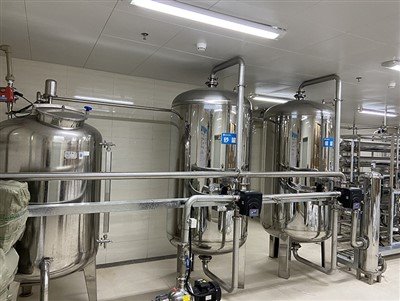
Abstract: Laboratory pure water systems are commonly used to produce high-purity water. High-purity water primarily refers to water that has completely removed conductive media, non-dissociated gases, colloids, and organic matter (including bacteria). Ultrapure water is a type of high-purity water that almost completely removes conductive media, non-dissociated gases, colloids, and organic matter (including bacteria). Its conductivity is typically 0.1~0.055 μS/cm, resistivity (25°C) > 10 x 10⁶ O/cr, and salt content is 0.1 mg/L. Ideal pure water (theoretically) has a conductivity of 0.055 μS/cm and a resistivity of 18.3 x 10⁶ Ω/cm.
Technical Principles of Laboratory Pure Water Systems:
Adopting advanced reverse osmosis and ion exchange technologies, and controlled by a microcomputer single-board program, the system automatically displays water quality data to obtain high-quality output water. The output resistivity can typically reach 18 mA/cm. Components include a booster pump, electromagnetic wetting, high-capacity ion exchange resin, RO reverse osmosis membrane, filter cartridges, pipe connectors, control components, and ultraviolet lamps.
The principle of reverse osmosis is to apply pressure greater than the natural osmotic pressure to the raw water side, causing water molecules to permeate from the high-concentration side to the low-concentration side. Because the pore size of the reverse osmosis membrane is hundreds of times smaller than that of viruses and bacteria, or even several times smaller, various diseases, bacteria, heavy metals, soluble solids, organic pollutants, calcium, and magnesium ions cannot pass through the reverse osmosis membrane for purification.