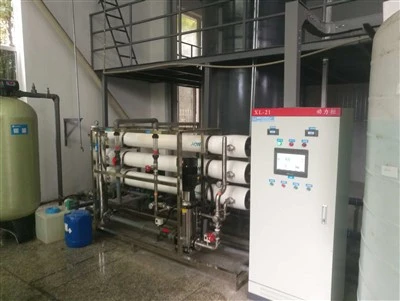
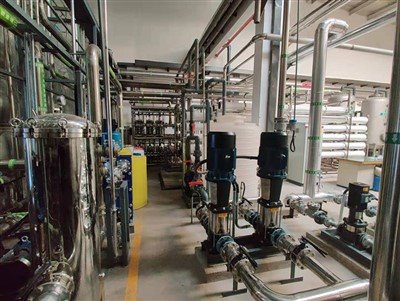
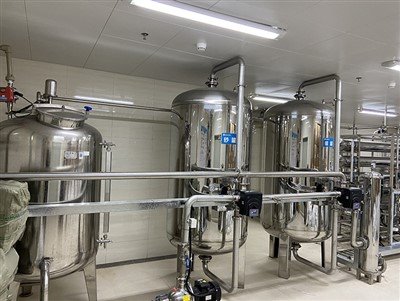
A Reverse Osmosis Deionizer for coolants is a water treatment unit that produces low-conductivity, low-mineral water used to make up or dilute industrial coolants-such as water-glycol, machining coolants, closed-loop chiller water, and heat-transfer fluids.
Why Use Ro-di Water For Coolants?
- Prevents scale & deposits: removes calcium/magnesium and silica that form scale on heat exchangers and pipes.
- Reduces corrosion risk: lowers chlorides/sulfates and stabilizes water chemistry (with proper inhibitors).
- Improves heat transfer: cleaner surfaces = better cooling efficiency.
- Extends coolant life: fewer ions and contaminants slow coolant degradation and reduce sludge/biofouling.
- More consistent mixing: stable water quality improves repeatability from batch to batch.
Typical Ro-di Coolant Water Targets
(Depends on system type and OEM specs)
- Low conductivity (commonly tens of µS/cm or lower for closed loops)
- Very low hardness (often near zero)
- Low chloride/sulfate
- Low silica (important for high-temp or sensitive heat exchangers)
Typical RO-DI system configuration for coolant makeup
1. Pretreatment
Sediment / multimedia filter (particles)
Activated carbon (chlorine/chloramine, organics) if on municipal water
Softener or antiscalant (if hardness/silica is high)
2. Reverse Osmosis (RO)
Removes most dissolved salts and organics
3. Deionization (DI) polishing
Mixed-bed DI or separate cation/anion beds to reach low conductivity
4. Optional add-ons
UV sterilizer / biocide strategy (if biological growth is an issue)
Final cartridge filter (1–5 µm) for cleanliness
Storage tank + recirculation loop (helps keep quality stable)
Key Points When Selecting/spec'ing
- Coolant type & use: closed-loop HVAC/chillers vs metalworking coolants vs water-glycol have different needs.
- Required makeup flow (m³/hr or L/min) and daily volume.
- Raw water report: TDS, hardness, silica, chloride, alkalinity, iron/manganese.
- Target water spec: conductivity/resistivity + limits for chloride, hardness, silica.
- Materials & controls: corrosion-resistant piping, conductivity monitoring, automatic DI changeover (if needed).
If you tell me:
(1) coolant type
(2) required flow
(3) raw water TDS/hardness/silica (or a water analysis)
(4) target conductivity or OEM spec
I can suggest a suitable Reverse Osmosis Deionizer For Coolants
Main Components

Successful Cases


Our Service
a.We provide full technical support and after equipment installation.
b.We help to train operator of the system. And detailed operating manual is provided.
c.7*24 hours phone assistance on technical support.
d.We provide consumable and spare parts in the long-term for cost price.
Hot Tags: reverse osmosis deionizer for coolants, China reverse osmosis deionizer for coolants manufacturers, suppliers, factory, di pure water machine, di pure water system, Reverse Osmosis Deionized Water System, ro deionization equipment, ro di water filtration equipment, ro di water filtration plant